
👉 Try our free UK Energy Bill Calculator
The Situation
I’ll never forget opening that first email from Utility Warehouse in December 2025, exactly one month after moving to the UK. The subject line read: “Your December energy statement is ready.” I clicked it expecting something straightforward—maybe like the utility bills back home where you see your usage, a rate, and a total. Simple math.
Instead, I stared at a PDF that might as well have been written in another language.
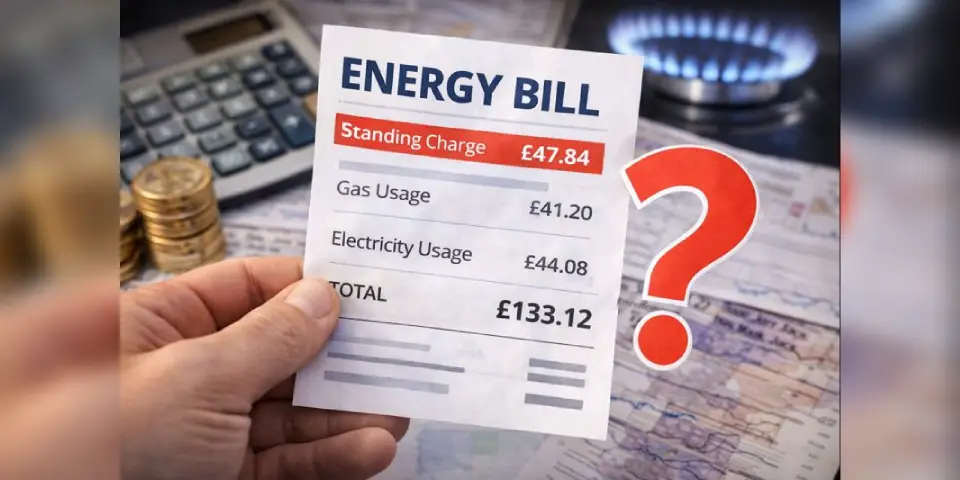
Standing charge. What’s standing for? Is something literally standing somewhere consuming energy? Unit rate. Units of what? The bill showed 287 kWh for electricity but then a completely different number—1,247 kWh—for gas. How is gas measured in the same units as electricity? VAT at 5%. Wait, there’s a special tax rate just for energy? Daily charges multiplied by 31 days. I thought this was a monthly bill?
The total at the bottom: £186.43. For one month. In a one-bedroom flat where I was barely home because of my night shifts.
I sat there feeling a mix of confusion and panic. Was this normal? Was I being overcharged? Did I somehow use a ridiculous amount of energy without realizing it?
As a newcomer, I had no frame of reference. No British friends to text and ask “is £186 normal for December?” No context for what these terms meant or whether these numbers made sense.
That confusion—that specific feeling of “I’m supposed to understand this adult thing but I have absolutely no idea what I’m looking at”—is why I’m writing this post. Because I researched every single line until it made sense, and I want to save you those hours of confusion.
What I Didn’t Know (But Now Do)
After spending an entire Saturday researching (yes, really—about 4 hours total), I finally understood what I was looking at. Here’s what I learned:
The UK Energy Bill Structure
According to Ofgem (the energy regulator), every UK energy bill has the same basic structure, whether you’re with Utility Warehouse, British Gas, Octopus, OVO, or any other supplier:
1. Standing Charge (Daily fixed cost)
This is what you pay just for being connected to the energy network
- Charged daily, regardless of whether you use any energy
- Covers the cost of maintaining the infrastructure (pipes, cables, meter)
- Typically shown as pence per day (p/day)
On my bill:
- Electricity standing charge: 46.25p/day × 31 days = £14.34
- Gas standing charge: 28.83p/day × 31 days = £8.94
→ That’s £23.28 just for being connected. I could have been away the entire month and still owed this amount.
This was my first “aha!” moment—coming from a country where you only paid for what you used, the concept of paying daily just to be connected was completely foreign.
2. Unit Rate (Variable cost per unit consumed)
This is what you pay for actual energy consumption
- Electricity measured in kilowatt-hours (kWh)
- Gas also measured in kWh (this confused me initially)
- Rate shown as pence per kWh (p/kWh)
On my bill:
- Electricity: 24.50p/kWh for 287 kWh used = £70.32
- Gas: 6.04p/kWh for 1,247 kWh used = £75.32
Important discovery: Gas isn’t measured in kWh at your meter—it’s measured in cubic meters (m³) or cubic feet. But it’s converted to kWh on your bill using a standard calculation. This is why the meter reading and the bill units don’t match. (This took me an hour to figure out.)
3. VAT (Tax at 5%)
- Energy bills are taxed at 5% VAT (not the standard 20%)
- Applied to the total of standing charges + unit rates
- Reduced rate because energy is considered an essential service
On my bill: (£23.28 + £70.32 + £75.32) × 5% = £8.45
4. Total Amount Due
Standing charges + unit rates + VAT = your bill
→ My December total: £186.43
Calculate Your Own Bill
Now that you understand the components, try calculating your own monthly energy cost for free: 👉 UK Energy Bill Calculator
The Format That Confused Me
My Utility Warehouse bill showed all of this in a table format that looked like:
Supply Period: 01/12/2025 - 31/12/2025 (31 days)
ELECTRICITY
Standing Charge: 46.25p/day × 31 days = £14.34
287 kWh @ 24.50p/kWh = £70.32
Subtotal: £84.66
GAS
Standing Charge: 28.83p/day × 31 days = £8.94
1,247 kWh @ 6.04p/kWh = £75.32
Subtotal: £84.26
VAT @ 5%: £8.45
Total Amount Due: £186.43
What made this confusing:
- The mixing of daily rates (standing charges) with usage rates
- The conversion of gas from m³ to kWh (not explained on the bill)
- The 5% VAT (I expected 20% like everything else)
- No context for whether these numbers were high or low
(… rest of your article continues unchanged from here onward …)
Why Gas Shows kWh (The Conversion Mystery)
This deserves its own explanation because it bothered me for days. Your gas meter measures volume—either cubic meters (m³) if you have a metric meter, or cubic feet (ft³) if you have an older imperial meter. But your bill shows kWh (kilowatt-hours)—the same unit as electricity. Why? Because different gases have different energy content. By converting to kWh, they’re measuring the energy you used, not just the volume of gas. The conversion formula (per Ofgem regulations): Read your meter (gets you m³ or ft³) Convert to m³ if needed (1 m³ = 35.3 ft³) Multiply by volume correction (accounts for temperature/pressure) Multiply by calorific value (energy content of the gas that month) Divide by 3.6 to get kWh On my bill, buried in the small print: Meter reading: 1,247 m³ Calorific value: 39.3 MJ/m³ After conversion: 1,247 kWh (they do this calculation for you) Understanding this made me feel slightly less confused, but also made me think: Why don’t they just explain this clearly on the bill?
The Resolution
My “resolution” wasn’t solving a problem—it was understanding what I was looking at. But that understanding led to important questions I could now answer:
Question 1: Is £186 normal for December?
After researching on MoneySavingExpert forums and Ofgem’s typical consumption data:
- Typical December bill for 1-bed flat:
- Ofgem typical usage: ~242 kWh electricity, ~1,000 kWh gas per month in winter
- My usage: 287 kWh electricity (slightly above average), 1,247 kWh gas (above average)
- Why mine was higher:
- I kept heating at 20°C constantly (didn’t know about thermostatic radiator valves)
- Older building with poor insulation
- Didn’t understand how to use the timer on the boiler
- First winter month—hadn’t adjusted usage behavior yet
- Verdict: Not outrageously high, but definitely room for improvement.
Question 2: Are these rates good or bad?
I compared my rates to Ofgem’s January 2026 price cap:
- Price Cap (typical dual fuel, my region):
- Electricity: 24.50p/kWh unit rate, 60.99p/day standing charge
- Gas: 6.04p/kWh unit rate, 31.43p/day standing charge
- My rates (Utility Warehouse):
- Electricity: 24.50p/kWh unit rate, 46.25p/day standing charge ✅
- Gas: 6.04p/kWh unit rate, 28.83p/day standing charge ✅
- Verdict: I was on the price cap (the maximum suppliers can charge), but my standing charges were actually lower than the cap maximum. Likely because I’m in London where standing charges are typically lower. This was good news—I wasn’t being ripped off. But it also meant there wasn’t much room to reduce costs by switching (since everyone is at or near the cap).
Question 3: Where’s my meter reading?
This confused me because the bill showed “estimated” next to my readings. I learned:
- Suppliers estimate if you don’t submit readings
- Estimates based on historical data (which doesn’t exist for new tenancies)
- First bills are often estimated then corrected later
- You can (and should) submit actual readings monthly I found my meters (electric in hallway cupboard, gas under kitchen sink), took photos of the readings, and submitted them through the Utility Warehouse app. My next bill would be accurate.
Total time invested:
- Research: 4 hours spread over a Saturday
- Taking and submitting meter readings: 15 minutes
- Result: Complete understanding of my energy bill structure
How to Read Your First UK Energy Bill (Action Steps)
If you’re staring at your first UK energy bill feeling as confused as I did, here’s exactly what to do:
Step 1: Identify the Basic Components
Look for these sections on your bill:
✓ Supply Period: The dates covered (usually monthly or quarterly)
✓ Standing Charges:
- Shown as pence per day (p/day)
- Multiplied by number of days in period
- One for electricity, one for gas (if you have both)
✓ Unit Rates: - Shown as pence per kWh (p/kWh)
- Your consumption (kWh) × rate = cost
- One rate for electricity, one for gas
✓ VAT: 5% on the total
✓ Total Amount Due: Everything added up
Step 2: Verify Your Consumption Makes Sense
For electricity (kWh):
- 1-bed flat: typically 150-300 kWh/month
- 2-bed flat: typically 250-400 kWh/month
- 3-bed house: typically 300-500 kWh/month
For gas (kWh) in winter:
- 1-bed flat: typically 800-1,200 kWh/month
- 2-bed flat: typically 1,000-1,500 kWh/month
- 3-bed house: typically 1,500-2,500 kWh/month
If your numbers are way higher:
- Check if reading is “estimated” or “actual”
- Submit your actual meter readings
- Consider if you’ve left heating on constantly
If your numbers seem way lower:
- You might be away a lot
- You might have very efficient usage
- Or it’s estimated and will be corrected
Step 3: Check If You’re Being Overcharged
Compare your rates to the current price cap:
- Check Ofgem’s price cap calculator:
- Visit: www.ofgem.gov.uk/energy-price-cap
- Enter your postcode
- See the maximum rates for your region
- Compare to your bill
- Your rates should be AT OR BELOW these numbers. If they’re higher, something’s wrong—contact your supplier.
Step 4: Understand Estimated vs Actual Readings
Look for these indicators:
- “E” = Estimated
- “A” = Actual (from meter reading)
- “C” = Customer reading (you submitted it)
If your first bill is estimated:
- This is normal for new accounts
- Find your meters (check cupboards, kitchen, outside)
- Take photos of the readings
- Submit through supplier’s app or website
- Next bill will be corrected to actual usage
Where to find meters:
- Electricity: Usually in hallway cupboard, under stairs, or outside
- Gas: Often under kitchen sink, in cupboard, or outside in meter box
Step 5: Set Up Regular Meter Readings
To avoid estimated bills:
- Take readings same day each month
- Submit through:
- Supplier’s mobile app (easiest)
- Supplier’s website
- Automated phone line
- Set a monthly phone reminder
- Pro tip: I take readings on the 1st of every month. Submitted by the 2nd. Takes 2 minutes total.
💡 Compare Current Energy Deals:
Before you accept your rates as final, worth checking what else is available:
- Compare The Market Energy - Compare all suppliers
- Uswitch Energy Comparison - Often shows exclusive deals
- MoneySuperMarket Energy - Quick comparison tool
These are affiliate links - I may earn a small commission if you use them, at no extra cost to you.
Resources That Helped Me
When I was researching all of this, these were the most helpful sources:
Official Resources:
- Ofgem: Understanding Your Energy Bill - Official regulator guide
- Citizens Advice: Energy Bills Explained - Clear breakdown with examples
- GOV.UK: Energy Bills Support - Government resources and schemes
Comparison & Context:
- Ofgem Price Cap Calculator - Check maximum rates for your area
- Energy Saving Trust: Typical Consumption - See if your usage is normal
Community Forums (Real Experiences):
- MoneySavingExpert Energy Forum - Active community discussing bills, rates, issues
- Reddit r/UKPersonalFinance Energy Threads - Newcomers often ask bill questions here
Bill Calculators:
- Utility Warehouse Bill Guide - Understanding your UW bill
- Octopus Energy Bill Breakdown - Great visual explanation
- British Gas Bill Estimator - Check if your consumption is typical
Key Takeaways
After going from complete confusion to understanding my first UK energy bill, here’s what I learned:
Understanding the structure:
- Standing charges are daily fixed costs for being connected (you pay these even if you use zero energy)
- Unit rates are what you pay per kWh of actual consumption
- Gas is converted to kWh on your bill (even though your meter shows m³ or ft³)
- 5% VAT applies to energy bills (not the standard 20%)
What I’d do differently:
- Take meter readings on move-in day (prevents estimated first bill)
- Research typical consumption for my flat size before panicking
- Set up the supplier app immediately for easy reading submissions
- Ask landlord about insulation and heating efficiency before renting
What I’m glad I learned:
- How to read any UK energy bill now (they’re all structured the same)
- Where my meters are and how to read them
- How to verify I’m not being overcharged
- The difference between supplier, network operator, and National Grid
- That £186 for December in a 1-bed wasn’t crazy (though it could be lower)
If you’re confused by your first bill:
- You’re not alone—every newcomer goes through this
- The structure is standardized, so once you understand one bill, you understand them all
- It’s worth taking the time to learn this (you’ll be paying these bills monthly for years)
- Most confusion comes from estimated readings—submit actual readings to fix this
- Your first winter bill will likely be your highest (summer bills are much lower)
The UK energy system feels needlessly complicated at first. But it’s learnable. And understanding your bill is the first step to controlling your costs.
Related Content
How to Switch UK Energy Providers (First-Timer’s Guide) - Step-by-step process
Understanding UK Standing Charges By Region - Why London pays less
My Gas Got Capped by Cadent - What I Learned - Network operators explained
Got your first UK energy bill and feeling confused? Drop your questions in the comments below. I remember exactly how overwhelming it feels, and I’m happy to help decode it.