
Date
January 18, 2026
How to Read Your UK Energy Bill - Every Line Explained (2026 Guide)
Last updated: 18 January 2026 | Reading time: ~15 minutes
My first UK energy bill arrived three weeks after I moved here.
I opened it expecting something similar to what I’d seen in my home country - maybe a few lines, a total, a due date. Simple.
Instead, I got two pages of dense tables, mysterious codes, multiple rates, daily charges that seemed to apply even when I wasn’t using energy, meter readings marked with letters I didn’t understand, and a total that seemed impossibly high for someone who’d barely turned the heating on.
I Googled “UK energy bill explained.”
Every result assumed I already knew what MPAN, kWh, standing charges, and calorific values meant.
I asked my landlord.
”Yeah, they’re confusing. Just pay it.”
Not helpful.
So I did what I’ve learned to do in the UK when official systems make no sense: I sat down with my bill, multiple tabs open, and decoded it line by line until I understood where every single penny was coming from.
That process revealed something infuriating: UK energy bills are deliberately designed for people who already understand them.
If you’re new to the UK, or just confused by your bills, this guide is what I wish I’d had in week one.
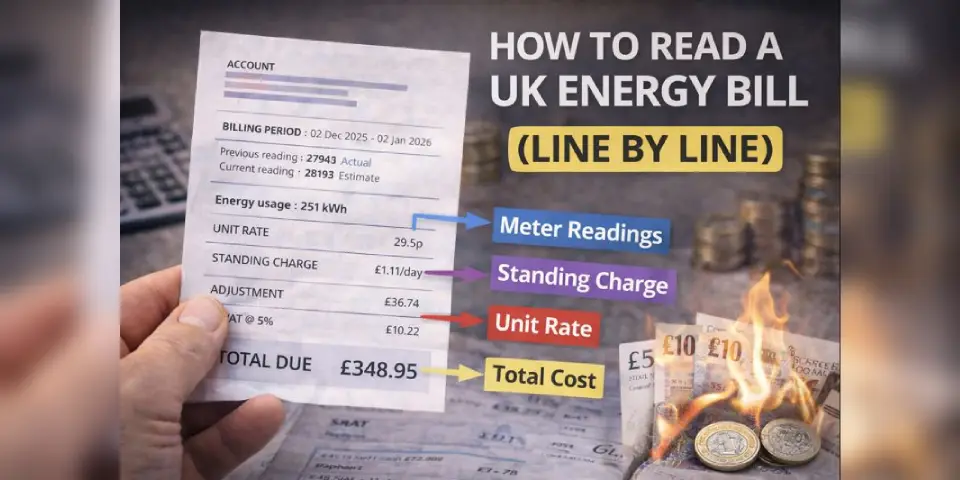
We’re going line by line through an actual UK energy bill, explaining every code, every charge, every mysterious abbreviation, and - critically - how to spot when something is wrong.
What This Guide Actually Covers
This isn’t a quick overview. This is a complete breakdown:
The Anatomy of a Bill:
- Account and billing information (what matters, what doesn’t)
- Supply numbers (MPAN/MPRN) and why they’re important
- Meter readings (Actual vs Estimated vs Customer)
- Energy usage in kWh (and the gas conversion that confuses everyone)
- Unit rates (why you might see multiple rates)
- Standing charges (the daily cost nobody explains)
- Adjustments and credits (where surprise charges hide)
- VAT (why it’s 5%, and when to question it)
- Payment details (direct debit vs prepaid vs standard credit)
The Practical Skills:
- How to check if your bill is correct (5-minute process)
- Common billing errors and red flags
- What to do if readings don’t match
- When estimated readings become a problem
- How to challenge incorrect charges
Real Examples:
- Annotated bill showing every component
- Calculation breakdowns you can follow
- Comparison of different bill types (variable vs fixed, gas vs electric)
Who needs this guide:
- Newcomers to the UK (obviously)
- International students in private rentals
- Anyone who just received a confusing first bill
- People whose bills suddenly jumped without explanation
- Anyone sharing a rental and splitting costs
Why UK Energy Bills Are So Confusing (It’s Not Just You)
Before we dive into the specifics, let’s acknowledge something important:
UK energy bills are genuinely complicated.
This isn’t your fault. It’s not because you’re “bad at bills.” It’s because the UK energy system has:
- Multiple layers (suppliers, network operators, national grid)
- Regional variations (different rates by postcode)
- Multiple payment methods (each billed differently)
- Quarterly price changes (rates can change mid-bill)
- Complex metering (smart, traditional, Economy 7, prepaid)
- Historical pricing rules (standing charges, dual-rate tariffs)
- Regulatory jargon (Ofgem, MPAN, MPRN, kWh, calorific value)
In most countries, you pay for what you use at one rate. Simple.
In the UK, you pay:
- For what you use (unit rate)
- For being connected (daily standing charge)
- Sometimes at different rates depending on time of day
- In a currency (pence per kWh) that requires mental math
- With conversions (for gas) that nobody explains
- Under regulations that change quarterly
And all of this is presented on a bill format that assumes you already understand it.
So if you find your UK energy bill confusing, you’re not failing - you’re having the normal human response to an unnecessarily complicated system.
Now let’s decode it.
The Structure of a UK Energy Bill (What to Expect)
Most UK energy bills follow this basic structure across pages 1-2:
PAGE 1:
- Account summary (who you are, what you owe)
- Bill overview (dates, total, payment method)
- Charges breakdown (this month’s costs)
- Graph or usage comparison (how much you used)
- Tariff information (your current rates)
- Marketing content (ignore this)
PAGE 2: 7. Detailed charge calculations (the math) 8. Meter readings history (actual vs estimated) 9. Supply reference numbers (MPAN/MPRN) 10. Contact information and T&Cs
We’ll go through each section with real examples.
SECTION 1: Account & Billing Information
This is the top of page 1. It looks administrative and boring, but it contains critical information.
What You’ll See:
Account Number:
Example: 123456789
What it is: Your unique customer reference with this supplier.
Why it matters: Quote this when calling customer service, submitting meter readings, or disputing charges. Write it down somewhere accessible.
Billing Period:
Example: From 14 Nov 2025 to 13 Dec 2025 (30 days)
Why this confuses newcomers:
Billing periods are NOT calendar months.
They often run from mid-month to mid-month (like the 14th to the 13th).
This means:
- Your “December bill” might include half of November and half of December
- If you moved in on December 1st, your first bill might only cover 13 days
- If the price cap changed on January 1st, your bill might show two different rates
Why this matters:
Understanding the exact billing period explains why:
- Your bill seems unexpectedly high (it covers 35 days, not 30)
- You’re being charged two different rates (period spanned a price change)
- Your usage looks weird (partial month)
Bill Date vs Due Date:
Bill Date: When the bill was generated (e.g., 15 Dec 2025)
Due Date: When payment is expected (e.g., 5 Jan 2026)
If you’re on direct debit, the due date is when they’ll take payment.
If you’re on prepaid, this doesn’t apply (you pay as you go).
If you’re on standard credit, you must pay by this date to avoid issues.
SECTION 2: Supply Numbers (The Codes That Identify Your Property)
Buried somewhere on your bill (usually page 2, sometimes page 1) are two crucial numbers you’ve probably never noticed.
MPAN (Electricity Supply Number)
Full name: Meter Point Administration Number
Also called: Supply number, S number
What it looks like:
S 01 801 101 22 6130 5588 165It’s 21 digits long, often displayed in two rows. The important part is the bottom row (13 digits): 6130 5588 165
Where to find it:
- Usually top left or bottom right of your electricity bill
- NOT on the actual meter (common mistake)
- In your online account under “supply details”
Why it matters:
- Uniquely identifies your electricity connection point
- Required when switching suppliers
- Needed if you move house
- Essential for reporting power outages
- Helps prove which property you’re talking about
Regional Information Hidden in MPAN: The first few digits tell you which distribution network operates in your area. This determines your standing charges and who to call for power cuts.
MPRN (Gas Supply Number)
Full name: Meter Point Reference Number
Also called: M number, gas supply number
What it looks like:
1875258102It’s 6-10 digits long, all numbers, no letters.
Where to find it:
- On your gas bill (marked “Meter Point Reference” or “MPRN”)
- Actually on your gas meter box (unlike MPAN)
- Under “Details of Charges” section
Special note:
If your MPRN starts with 74 or 75, you’re supplied by an Independent Gas Transporter (IGT). This can mean slightly higher charges, though Ofgem now caps IGT rates too.
Why it matters:
- Same reasons as MPAN
- Identifies your specific gas connection
- Different from your meter serial number (common confusion)
Meter Serial Number (MSN) - NOT the Same Thing
What it looks like:
Mix of letters and numbers: AB123456789
What it is:
Identifies the physical meter device, not the property.
Key difference:
- MPAN/MPRN stays the same if you get a new meter
- MSN changes when meter is replaced
- MSN is on the actual meter (look for barcode)
SECTION 3: Meter Readings (The Source of Most Billing Confusion)
This is where bills often go wrong. Your meter readings determine how much energy you used, which determines what you pay.
The Reading Types:
Every meter reading on your bill has a letter code:
A - Actual Reading
✅ What it means: Someone (meter reader, engineer, or smart meter) read the actual number on your meter.
✅ Accuracy: Highest - this is reality.
✅ What to do: Nothing, this is ideal.
E - Estimated Reading
⚠️ What it means: Your supplier guessed based on:
- Previous usage patterns
- Historical data from property
- National averages for similar homes
⚠️ Accuracy: Can be wildly wrong, especially:
- If you just moved in (they’re using previous tenant’s usage)
- If your usage changed (turned heating on for first time)
- If property was empty before you moved in
⚠️ What to do: Submit actual reading immediately to correct.
C - Customer Reading
✅ What it means: You submitted this reading (online, phone, app).
✅ Accuracy: As good as you made it. Double-check you entered correctly.
✅ What to do: Keep a photo of meter when you submit readings.
S - Smart Meter Reading
✅ What it means: Your smart meter automatically sent this reading.
✅ Accuracy: Very high, but check occasionally that meter is communicating.
✅ What to do: Nothing, but verify occasionally in supplier app.
Why This Matters:
Scenario 1: Long Run of Estimated Readings
If you see 3+ months of “E” readings in a row, you’re heading for a problem.
What happens:
- Supplier is guessing every month
- Eventually they’ll get an actual reading
- Sudden correction bill arrives for hundreds of pounds
- You’ll either owe a large amount OR get a refund
Example:
Nov 2025: 450 kWh (E)
Dec 2025: 480 kWh (E)
Jan 2026: 500 kWh (E)
Feb 2026: 1,800 kWh (A) ← Actual reading shows you used way less
Result: £150 refund coming, but months of overpaying.
OR:
Nov 2025: 300 kWh (E)
Dec 2025: 320 kWh (E)
Jan 2026: 340 kWh (E)
Feb 2026: 1,200 kWh (A) ← Actual reading shows you used way more
Result: £200 surprise bill.
How to avoid: Submit meter readings monthly, even if supplier doesn’t ask.
How to Read Your Meter (Because Nobody Shows You)
Traditional Electric Meter:
- Read the numbers left to right
- Ignore red numbers (they’re decimals, not counted)
- Ignore any numbers after a decimal point
- Example: If meter shows 12345.67, you read “12345”
Traditional Gas Meter:
- Same as electric - left to right, ignore red/decimal
- Measured in cubic meters (m³) or cubic feet (ft³)
- Supplier converts this to kWh on your bill
Digital/Smart Meter:
- Press button until you see “kWh” or current reading
- May need to press multiple times through different screens
- Write down ONLY the kWh reading
Economy 7 Meter (Dual Rate):
- Shows TWO readings: Day and Night
- Usually marked “Normal” and “Low” or “R1” and “R2”
- Submit BOTH when giving readings
- Messing this up causes billing chaos
SECTION 4: Energy Usage (kWh - The Unit Nobody Explains)
Your bill will show usage in kilowatt-hours (kWh).
What Is a kWh? (The Honest Explanation)
Technical definition: One kilowatt-hour is using 1,000 watts of power for one hour.
Practical definition: It’s how energy companies measure what you use so they can charge you.
Real examples:
- Running a 2,000W heater for 30 minutes = 1 kWh
- Boiling a 3,000W kettle for 20 minutes = 1 kWh
- Running a 100W laptop for 10 hours = 1 kWh
- A 10W phone charger for 100 hours = 1 kWh
Why it’s confusing:
You think in “I turned the heating on for 4 hours” - but your bill shows “you used 240 kWh.”
There’s no intuitive connection until you learn that your gas boiler uses about 60 kWh per hour when running.
The Gas Conversion Formula (This Confuses Everyone)
Gas meters measure volume (how much gas flows through), not energy.
So your bill has to convert cubic meters (m³) into kWh using this formula:
kWh = Volume (m³) × Correction Factor × Calorific Value ÷ 3.6
Real example from a bill:
Meter reading start: 12345 m³
Meter reading end: 12545 m³
Volume used: 200 m³

Correction Factor: 1.02264 (altitude/pressure adjustment)
Calorific Value: 39.3 MJ/m³ (energy content of gas - varies)

Calculation:
200 × 1.02264 × 39.3 ÷ 3.6 = 2,242 kWh
Why this matters:
- You can’t compare your gas meter reading to your bill without this formula
- The calorific value changes slightly based on gas composition
- Your bill should show this calculation - check the math
Typical Usage (What’s “Normal”?)
Ofgem defines “typical” annual usage as:
- Electricity: 2,700 kWh/year
- Gas: 11,500 kWh/year
But this is meaningless because:
Small flat, one person:
- Electricity: 1,200-1,800 kWh/year
- Gas: 6,000-8,000 kWh/year
Medium house, 2-3 people:
- Electricity: 2,500-3,500 kWh/year
- Gas: 10,000-14,000 kWh/year
Large house, 4+ people:
- Electricity: 3,500-5,000 kWh/year
- Gas: 15,000-20,000+ kWh/year
Seasonal variation:
Gas usage in January (heating): 1,800 kWh
Gas usage in July (no heating): 200 kWh
That’s 9x difference in one property across the year.
SECTION 5: Unit Rates (What You Pay Per kWh)
Your bill shows the price per kilowatt-hour. As of January-March 2026:
Typical rates (variable tariff, direct debit):
- Electricity: 27.69p per kWh
- Gas: 5.90p per kWh
But you might see different rates because:
1. Time of Day (Economy 7 / Economy 10)
If you have Economy 7:
- Day rate (7am-midnight): ~32p/kWh
- Night rate (midnight-7am): ~17p/kWh
Why it exists: Cheaper night electricity if you can shift usage (storage heaters, EV charging).
The trap: If you use most energy during the day, Economy 7 can cost you MORE than a standard tariff.
2. Rate Changes Mid-Bill
If the price cap changed during your billing period:
Example:
Bill period: 15 Dec 2025 - 14 Jan 2026 (31 days)
Price cap change: 1 Jan 2026

Your bill shows:
Rate 1 (15 Dec - 31 Dec): 26.30p/kWh (17 days)
Rate 2 (1 Jan - 14 Jan): 27.69p/kWh (14 days)
This is normal and correct - not an error.
3. Regional Differences
Unit rates vary slightly by region (1-3p/kWh difference).
London typically pays less than rural Scotland for gas.
Rural areas often pay more for electricity (transmission costs).
4. Payment Method Differences
As of January 2026:
Direct Debit (cheapest):
- Electricity: 27.69p/kWh
- Gas: 5.90p/kWh
Prepayment (actually cheaper now!):
- Electricity: 26.60p/kWh
- Gas: 5.66p/kWh
Standard Credit (most expensive):
- Electricity: 29.88p/kWh
- Gas: 6.37p/kWh
Calculating Your Energy Costs
Simple formula:
Energy cost = kWh used × rate in pence ÷ 100Example:
You used 450 kWh electricity in December
Rate: 27.69p/kWh

450 × 27.69 ÷ 100 = £124.61
That’s your usage cost. But that’s not your total bill yet…
SECTION 6: Standing Charges (The Daily Cost You Can’t Avoid)
This is the line item newcomers hate most.
What it is:
A fixed daily charge for being connected to the energy network.
As of January-March 2026:
- Electricity: 54.75p/day
- Gas: ~35p/day
- Total daily cost: ~90p/day just to stay connected
Annual impact:
- Electricity: 54.75p × 365 = £199.84/year
- Gas: 35p × 365 = £127.75/year
- Total: £327.59/year before you’ve used a single kWh
What Standing Charges Actually Cover:
Electricity:
- Maintaining the wires and cables to your property (26%)
- Running the meter (12%)
- Supplier operating costs - call centers, billing systems (16%)
- Policy costs - Warm Home Discount, green schemes (15%)
- Debt recovery from other customers who didn’t pay (18%)
- Other network and system costs (13%)
Gas:
- Supplier operating costs (majority)
- Policy costs (Warm Home Discount, Green Gas Levy)
- Metering
Note: Network costs for gas are in the unit rate, not standing charge. That’s why gas standing charges are lower.
Why Standing Charges Hurt Low Users Most
Example 1: Heavy User
- Uses 4,500 kWh electricity/year
- Standing charges: £200/year
- Usage costs: £1,246/year
- Total: £1,446/year
- Standing charges = 14% of bill
Example 2: Light User
- Uses 1,200 kWh electricity/year
- Standing charges: £200/year
- Usage costs: £332/year
- Total: £532/year
- Standing charges = 38% of bill
Same daily standing charge. Completely different impact.
If you live alone in a small flat and barely use energy, standing charges dominate your bill.
Can You Avoid Standing Charges?
Short answer: No.
Longer answer: A few suppliers offer “zero standing charge” tariffs, but they compensate with much higher unit rates. For low users, this can save money. For average/high users, it costs more overall.
Calculate before switching:
Zero standing charge only helps if:
Your annual kWh × (higher unit rate - standard rate) < annual standing chargesFor most people, standard tariffs with standing charges work out cheaper.
SECTION 7: Adjustments & Credits (Where Surprise Charges Hide)
This section appears when something changed since your last bill.
Common Adjustments:
1. Balance Brought Forward
Previous balance: -£45.00This means:
- You were £45 in credit last month
- This reduces this month’s bill by £45
OR:
Previous balance: £23.50This means:
- You owed £23.50 from last time
- Gets added to this month’s bill
Why this happens: Estimated readings created over/underpayments that get corrected.
2. Meter Reading Correction
Adjustment: -£78.00
Reason: Previous estimated reading corrected
What happened:
- Previous bills used estimated readings
- Actual reading showed you used less
- Refund applied
OR:
Adjustment: £112.00
Reason: Previous estimated reading corrected
What happened:
- Previous bills underestimated your usage
- Catch-up charge applied
This is why you should submit monthly readings.
3. Tariff Change Mid-Period
Adjustment: £14.50
Reason: Tariff change backdated to 1 January
Supplier applied new rates, adjusting previous charges.
4. Emergency Credit Repayment (Prepaid Meters)
Adjustment: £10.00
Reason: Emergency credit repaid
You used emergency credit last period - now being deducted from your top-up.
5. Warm Home Discount
Credit: -£150.00
Reason: Warm Home Discount applied
Government scheme - £150 off for eligible households.
Red Flags in Adjustments:
🚩 Large unexplained adjustment (£100+) with no clear reason
→ Call supplier immediately, request breakdown
🚩 Repeated corrections every bill
→ Submit your own readings monthly
🚩 Adjustments for periods before you moved in
→ Challenge with proof of move-in date
🚩 Duplicate charges for same period
→ Billing error - demand correction
SECTION 8: VAT (And When It Should Raise Alarms)
Domestic energy in the UK is charged at 5% VAT.
This is unusually low (most goods are 20% VAT).
On Your Bill:
Energy charges: £100.00
VAT (5%): £5.00
Total: £105.00
When to Question VAT:
🚩 If VAT is higher than 5%
Domestic energy should NEVER be charged more than 5% VAT. If you see 20%, your account is miscategorized as business.
🚩 If there’s no VAT line at all
All domestic energy includes VAT. If missing, check if it’s included in the rates or if there’s an error.
What to do:
Contact supplier, request account type correction, claim refund for overpaid VAT.
SECTION 9: Total Amount Due & Payment Details
Bottom of page 1 shows what you actually owe.
What You’ll See:
Previous charges: £0.00
This period charges: £98.45
Payments received: -£50.00 (if direct debit)
Balance: £48.45
Payment due: 5 Feb 2026
Payment Methods Explained:
Direct Debit:
- Monthly or quarterly automatic payment
- Usually based on estimated annual cost ÷ 12
- Supplier adjusts amount if usage changes
- Cheapest rates (£1,758/year typical)
Prepayment Meter:
- Pay before you use
- Top up at shops, online, or via app
- No monthly bill - pay as you go
- Now cheaper than direct debit (£1,711/year typical)
Standard Credit (Payment on Receipt):
- Bill arrives after you’ve used energy
- Pay quarterly when bill comes
- Most expensive (£1,894/year typical)
- Higher because of non-payment risk
My 5-Minute Bill Checking Process
Here’s exactly what I do when a bill arrives:
Step 1: Check Billing Period (30 seconds)
- How many days? (Should be 28-35 usually)
- Does it span a price change date? (Jan 1, Apr 1, Jul 1, Oct 1)
Step 2: Verify Meter Readings (1 minute)
- Are they Actual (A) or Estimated (E)?
- Do they match what’s on my meter right now?
- If Estimated, submit actual reading immediately
Step 3: Calculate Standing Charges (1 minute)
Days in period × daily rate = total standing charge
Example: 31 days × 54.75p = £16.97 electricity
         31 days × 35p = £10.85 gas
Does this match what’s on the bill?
Step 4: Check Unit Rates (1 minute)
- Are rates current (27.69p electricity, 5.90p gas as of Jan 2026)?
- If different, is there a valid reason (Economy 7, regional variation)?
Step 5: Review Adjustments (1.5 minutes)
- Are adjustments explained?
- Do they make sense?
- Any surprise charges?
Step 6: Verify VAT (30 seconds)
- Is it 5%?
- If not, why not?
Total time: ~5 minutes
Potential savings: £50-200/year from catching errors
Common Billing Errors (And How to Spot Them)
Error #1: Estimated Reading That’s Way Off
What it looks like:
Previous actual reading: 12,000 kWh
This estimated reading: 13,500 kWh (estimated you used 1,500 kWh)
Your actual meter reading: 12,300 kWh (you only used 300 kWh)
Result: You’re billed for 5x what you actually used.
Fix: Submit actual reading online immediately. Bill will be recalculated.
Error #2: Wrong Number of Days
What it looks like:
Billing period: 1 Dec - 31 Dec (31 days)
Standing charge calculation: 35 days × rate
Result: Overcharged for 4 days of standing charges.
Fix: Contact supplier, request correction.
Error #3: Wrong Tariff Applied
What it looks like:
You're on Octopus Flexible Tariff: 24.5p/kWh
Bill shows Standard Variable: 27.69p/kWh
Result: Paying 13% more per kWh than you should.
Fix: Provide proof of tariff (email confirmation), demand recalculation.
Error #4: Previous Tenant’s Debt Added to Your Account
What it looks like:
Adjustment: £340.00
Reason: Previous account balance
But you just moved in - this isn’t your debt.
Fix:
- Provide proof of move-in date (tenancy agreement)
- Provide opening meter reading from move-in day
- Demand charge removal
- Keep evidence - suppliers sometimes try this multiple times
What To Do If Your Bill Is Wrong
Step 1: Submit a Meter Reading
- Even if you think other things are wrong
- Gives you accurate starting point
- Do this TODAY
Step 2: Document Everything
- Take photos of meter
- Save screenshot of bill
- Note date/time of any calls
- Keep copies of emails
Step 3: Contact Supplier
By phone:
- Have account number ready
- Explain specific error
- Ask for reference number
- Request email confirmation of correction
By email/online:
- More evidence trail
- Can attach photos
- Get written response
Step 4: Escalate If Needed
If supplier doesn’t fix within 8 weeks:
- Complain to Energy Ombudsman (free service)
- Website: ombudsman-services.org/energy
- Phone: 0330 440 1624
Special Bill Scenarios
First Bill After Moving In
Expect confusion:
- Might only cover partial month
- Opening reading should match what you documented on move-in
- Watch for previous tenant’s charges
- Standing charges apply from day one
What to check:
- Opening reading matches your move-in photo
- No charges before your tenancy start date
- Correct tariff type from day one
Bill Spanning Price Cap Change
Example: Bill covers Dec 15 - Jan 14, price cap changed Jan 1
What you’ll see:
Dec 15 - Dec 31 (17 days):
- Electricity: 26.30p/kWh
- Gas: 6.30p/kWh

Jan 1 - Jan 14 (14 days):
- Electricity: 27.69p/kWh
- Gas: 5.90p/kWh
This is correct - two rates for two periods.
How to verify:
- Check dates match
- Verify old vs new rates are accurate
- Calculate each period separately
Final Bill When Moving Out
Should show:
- Final meter readings (your responsibility to provide)
- Charges up to move-out date only
- Refund of any credit balance
- Or final amount owed
Common issues:
- Supplier uses estimated final reading → challenge immediately
- Charges beyond your tenancy end → prove move-out date
- Credit not refunded → request within 10 days
Tools & Resources
Ofgem Price Cap Calculator:
Check current rates for your area
https://www.ofgem.gov.uk/information-consumers/energy-advice-households/check-if-energy-price-cap-affects-you
Energy Comparison Sites:
- Uswitch: www.uswitch.com/gas-electricity
- MoneySuperMarket: www.moneysupermarket.com/gas-and-electricity
- Which?: switch.which.co.uk
Find Your MPAN/MPRN:
www.findmysupplier.energy
Energy Ombudsman:
For complaints: www.ombudsman-services.org/energy
Citizens Advice:
Free energy advice: www.citizensadvice.org.uk/energy
Related Guides
Understanding the System:
- January 2026 UK Energy Price Cap - What It Actually Means
- The UK Energy Mistake That Cost Me £180
- UK Energy System Explained - Suppliers vs Network Operators
Taking Action:
- How to Switch UK Energy Providers - Complete First-Timer’s Guide
- Standing Charges By Region - Complete Data Analysis
- Prepaid vs Credit Meter - Which Costs Less?
Final Thoughts: From Confusion to Confidence
When I got my first UK energy bill, I felt stupid for not understanding it.
Now I realize: the confusion wasn’t my fault.
These bills are designed for people who already know the system - which excludes most newcomers, students, and plenty of UK natives too.
But once you understand the components:
- Where each charge comes from
- Why your bill might jump
- What’s normal vs what’s an error
- How to verify everything in 5 minutes
…bills stop being scary and start being just another piece of UK life admin you can handle.
The key skills you now have:
✅ You can verify your bill is correct
✅ You can spot common errors
✅ You can challenge wrong charges
✅ You understand what you’re actually paying for
✅ You can explain this to flatmates/partners
And most importantly:
You’re no longer at the mercy of a confusing system. You understand it.
Save this guide. Bookmark it. Share it with friends who are confused.
Every time a bill arrives, spend 5 minutes checking it using the process above.
Over a year, that 5 minutes per month could save you £100-300 in caught errors and optimized choices.
Worth it.
Still confused by something on your bill? Drop the specific line item in the comments with a photo (blur personal details) and I’ll help decode it.
Data sources:
Ofgem Official Publications (accessed 18 January 2026)
Citizens Advice Bill Guidance (accessed 18 January 2026)
Energy UK Consumer Resources (accessed 18 January 2026)
Actual bill examples from British Gas, Octopus Energy, EDF, OVO Energy
Price cap data: January-March 2026 period
All rates verified: 18 January 2026