
Date
February 21, 2026
Math Tug of War - Complete Guide (2026)
Last updated: 21 February 2026 | Reading time: ~12 minutes
I created Math Tug of War for a simple reason: my own children hated maths practice.
Sitting alone with worksheets. Timed tests that felt like punishments. The same boring drills every evening.
They’d groan, stall, make excuses. And I understood - who wouldn’t find that tedious?
So I built something different.
What if maths practice felt like a video game? What if every correct answer gave you power? What if siblings could compete head-to-head, with real stakes and real excitement?
That’s Math Tug of War.
Two players. One rope. A battle of speed and accuracy where every second counts and every answer matters.
Since launching it, I’ve watched children who “hate maths” beg to play another round. I’ve seen siblings who normally argue collaborate and compete in healthy ways. I’ve watched confidence grow as response times drop from 30 seconds to 8 seconds.
This guide shows you exactly how to play, what each mechanic does, and - most importantly - why this game actually works for building real mathematical fluency.
Whether you’re a parent, teacher, or just someone who remembers struggling with times tables, let’s dive in.
What Is Math Tug of War?
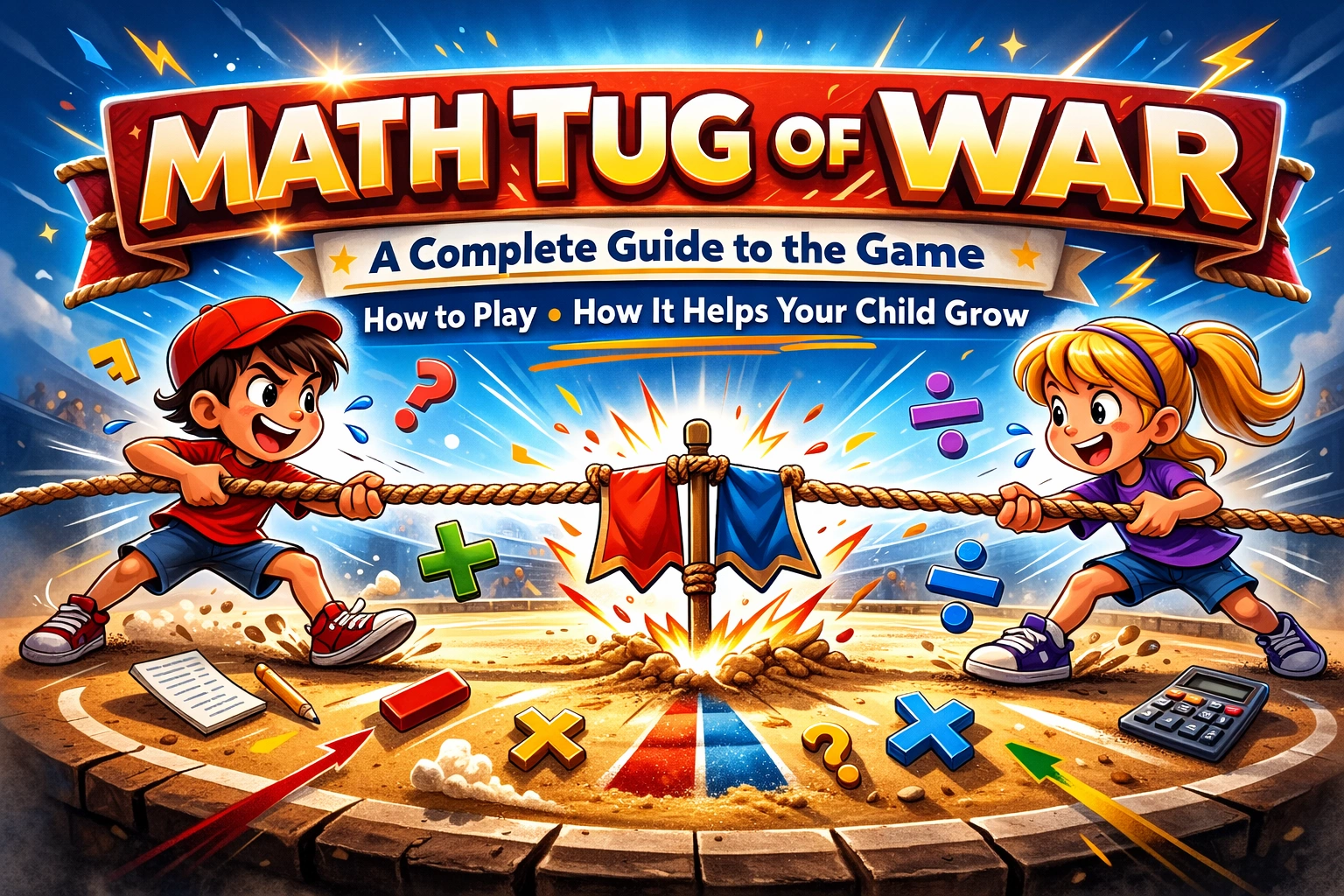
Math Tug of War is a two-player, turn-based arithmetic battle game built for families, classrooms, and study sessions.
Originally created by Armstrong Uzoagwa for his own children, it transforms everyday maths practice into a thrilling head-to-head competition.
How it works:
Two players — let’s call them Othniel and Zoe — take turns answering maths questions. Every correct answer pulls a rope flag towards their side of the arena. The faster they answer, the harder they pull. The first player to drag the flag all the way to the opponent’s edge wins.
🎯 The Core Idea
Instead of sitting alone with a worksheet, children compete against each other — making maths feel urgent, exciting, and rewarding. Every second counts. Every answer matters.
How to Play
Step 1 — Choose a Difficulty
Before the battle begins, select a difficulty that suits the players:
| Difficulty | Who It Is For | Example Questions |
|---|---|---|
| ⭐ Very Easy | Ages 4–6 · Early learners | 2 + 3 = ? · 7 − 4 = ? |
| Easy | Ages 6–8 · Primary school | 14 + 9 = ? · 18 − 7 = ? |
| Medium | Ages 8–11 · Lower secondary | 7 × 8 = ? · 36 + 47 = ? |
| Hard | Ages 11+ · Challenge level | 12 × 9 = ? · 144 ÷ 12 = ? |
Step 2 — The Countdown
Once you press Begin Battle, a dramatic 5-second countdown fills the screen — complete with a deep introductory phrase and a countdown boom for each second.
When the screen flashes FIGHT!, the game begins.
Step 3 — Taking Turns
Players alternate turns. Only one calculator is active at a time.
During your turn:
- Read the maths question displayed on your panel
- Type your answer using the number pad — or use the keyboard numbers
- Press ENTER (or the Enter key) to submit your answer
- The rope flag moves towards your side if you are correct
- Your opponent then gets their turn
⌨️ Keyboard Tip
Any number key on the keyboard automatically goes to whichever player’s turn it is. No need to click — just type and press Enter.
Step 4 — Speed Bonuses
Answering quickly earns extra pulling power. The power bar on each panel shows the current bonus level:
| Time Taken | Pull Power | Colour |
|---|---|---|
| 0 – 10 seconds | ⚡ +12% (Maximum) | Bright Green |
| 10 – 20 seconds | +10% | Yellow-Green |
| 20 – 30 seconds | +8% | Yellow |
| 30 – 40 seconds | +5% | Orange |
Why this matters:
Children naturally work to improve their response time — not because they’re told to, but because faster answers win more rope.
Step 5 — The Bonus Question System
This is the most exciting part of the game.
When a player misses a question or runs out of time, that exact question is handed to the opponent as a Bonus Question.
What happens next:
-
If the opponent answers the bonus correctly — they get 1.8× the normal pull power. A massive rope pull!
-
If the opponent also misses the bonus — they receive a heavy penalty of −10% on the rope position. Double shame!
-
If the first player answers correctly — no bonus is given. A fresh question goes to the opponent.
⭐ Why This Matters Strategically
Missing a question doesn’t just cost you — it hands your opponent a weapon. This creates genuine tension and teaches children that every attempt matters, even under pressure.
Step 6 — The Bleeding Timer
After 40 seconds on a single question, the flag begins to bleed — slowly drifting towards the opponent’s side every 5 seconds until the player submits an answer.
Purpose: This prevents stalling and keeps the game moving at all times.
Step 7 — Winning
The game ends when the rope flag reaches the Abyss zone on either side of the arena. The player who drags the flag all the way to their opponent’s edge wins.
The winning screen displays:
- Full match statistics — correct answers, wrong answers, accuracy, speed bonuses, best streaks
- Average response time per player
- An all-time leaderboard tracking wins across all sessions
How It Helps Your Child’s Development
Math Tug of War was designed with more than entertainment in mind. Every mechanic in the game serves a developmental purpose.
Here is what your child is building every time they play.
1. Mental Arithmetic & Number Fluency
The most direct benefit.
Children are not given calculators, worksheets, or unlimited time. They must retrieve answers from memory under real pressure.
This kind of repeated, timed retrieval is one of the most effective ways to build genuine number fluency — the ability to work with numbers quickly and confidently without needing external tools.
Research shows: Regular timed recall practice significantly improves working memory for numbers, which directly benefits performance across all STEM subjects.
2. Processing Speed
The speed bonus system directly rewards how quickly a child can process a question and produce an answer.
Over time, children naturally work to improve their response time — not because they are told to, but because faster answers win more rope.
This builds cognitive processing speed, which is one of the strongest predictors of academic performance and is closely linked to:
- Reading fluency
- Problem-solving ability
- Attention span
3. Resilience & Learning from Mistakes
The bonus question system is a deliberate resilience mechanic.
When a child misses a question, the game does not simply move on — the question returns as a bonus opportunity for their opponent.
This teaches children that:
- Mistakes have consequences, but they are not the end
- The same question can be answered correctly with a second look and less pressure
- Opponents can capitalise on your errors — so attention and effort matter at all times
This mirrors real academic and professional environments where errors provide learning opportunities rather than just penalties.
4. Working Under Pressure
The countdown timer, the bleeding mechanic, the screen effects, and the sound design all create a genuine sense of urgency.
Children learn to manage their anxiety and still perform — a critical life skill.
This is sometimes called performance under cognitive load, and it is directly relevant to:
- Exam conditions
- Timed tests
- Real-world decision-making situations children will encounter throughout their education
5. Competitive Motivation & Intrinsic Drive
Competing against a sibling, friend, or parent is one of the most powerful motivators in childhood learning.
Math Tug of War turns maths from a solitary, often dreaded task into something children voluntarily want to do — because winning matters to them.
This shift from extrinsic motivation (doing maths because a teacher said so) to intrinsic motivation (doing maths to beat their opponent) creates a fundamentally different relationship with the subject.
6. Attention & Focus
During their opponent’s turn, each player watches — knowing that the question might become a bonus if their opponent fails.
This keeps both players mentally engaged throughout the entire game, not just during their own turns.
This sustained attention training is particularly valuable for children who struggle with focus, as the game provides natural, game-driven reasons to stay alert.
7. Strategic Thinking
Older children begin to develop simple strategic awareness:
- Is it worth guessing to avoid the bleeding timer?
- Should I answer quickly for the speed bonus or take an extra second to be certain?
- What happens if I give my opponent a bonus question I know they might get wrong?
These are genuine logical trade-offs that build early reasoning and decision-making skills.
8. Positive Association with Mathematics
Perhaps the most important long-term benefit.
Many children develop maths anxiety early — a genuine fear and avoidance of the subject that can last into adulthood.
Playing Math Tug of War in a safe, fun, competitive environment helps children associate maths with:
- Excitement
- Achievement
- Laughter
…rather than fear and failure.
When a child wants to play a maths game, they are building the foundation for a healthy relationship with numbers that will serve them for life.
Quick Development Summary
| Skill Developed | Game Mechanic That Builds It |
|---|---|
| Number fluency | Answering maths questions from memory |
| Processing speed | Speed bonus tiers reward faster answers |
| Resilience | Missed questions return as opponent bonuses |
| Performance under pressure | Timer, bleed mechanic, sound, visual effects |
| Intrinsic motivation | Head-to-head competition with real stakes |
| Sustained attention | Both players engaged throughout every turn |
| Strategic thinking | Trade-offs between speed, accuracy, and timing |
| Positive maths association | Fun, exciting environment for every session |
Tips for Parents & Teachers
Getting Started
- Start on Very Easy — even older children enjoy an easy warm-up round before going competitive
- Sit beside young children (4–6) for their first few sessions to explain what the flag and rope represent
- Let children choose their own difficulty — ownership increases engagement
Making It a Routine
- 10 minutes before dinner is an ideal slot — short enough to feel manageable, long enough to see improvement
- Keep a mental note of each child’s best response time. Celebrate when they get faster
- Alternate who picks the difficulty to keep both players invested
In the Classroom
- Use as a 5-minute starter activity before a maths lesson — it primes the brain for number work
- Pair children of similar ability for the most productive matches
- The leaderboard persists across sessions — children are motivated to protect and improve their win count
- Hard difficulty works well as a challenge for early finishers or gifted students
Making It Fair
If one child is significantly stronger:
- Give the weaker player a head start by setting the flag to their side at the start (ask your developer to adjust the starting position)
Younger vs older:
- Let the younger child play on Very Easy while the older plays on the same questions but starts at a disadvantage
Adults vs children:
- Play on Hard difficulty and give yourself a 5-second delay before answering
Ready to Play?
Play the game at:
🔗 liwox.net/tools/math-tug-of-war
Full guide and tips:
📖 liwox.net/guides/math-tug-of-war
Final Thoughts: Why This Game Works
When I watch my children play Math Tug of War, I see something remarkable happen.
The groans disappear. The stalling stops. Instead, I hear:
“One more round!"
"I’m going to beat you this time!"
"Wait, let me try again — I know I can get faster!”
That’s the power of intrinsic motivation.
This isn’t about tricking children into learning. It’s about creating an environment where learning feels like play, where improvement feels like winning, and where maths becomes something to embrace rather than endure.
Every mechanic has a purpose:
- The rope creates visual progress
- The timer builds urgency
- The bonus system teaches resilience
- The competition fuels engagement
But the real magic happens when a child who once said “I hate maths” starts asking to play before dinner instead of after.
That’s when you know the game is working.
Created by Armstrong Uzoagwa · LiwoxDotNet · © 2026 All Rights Reserved
Have questions about the game? Want to share your child’s progress? Drop a comment below — I read every one.