
Date
January 25, 2026
📘 From $5 to $10,000 in 30 Days — The Full System
In my book “Scaling Micro Accounts in Forex”, I reveal the exact framework used to grow a $5 account into $10,000 in one month—using disciplined compounding, not gambling.
“This is the system behind the ForexDelight Tracker—now documented step by step.”
Get the Book on Selar →Tool Overview
The ForexDelight Trade Tracker turns abstract trading goals into a visible, measurable feedback loop. But as a beginner, the hardest part isn’t placing trades—it’s staying honest with yourself about risk, results, and recovery.
This guide gives you a safe, repeatable system to use the tracker and build real trading discipline—designed to solve the two biggest problems new traders face:
- Trading with fixed lots instead of scaled risk (leading to blown accounts)
- Confusing hope with performance (by not tracking real P&L)
By the end, you’ll know how to use the tracker before, during, and after every trade week—and turn $5 into proof of skill.
Key Lessons
-
Start With Capacity, Not Dreams (so you don’t blow up)
- What “Capacity” really means (it’s your live equity)
- Why Monday starts at $5.00 (and why that’s enough)
- How your next day’s capacity is set by yesterday’s truth
-
Track Actual Growth Relentlessly
- How to log real P&L (even if you didn’t trade)
- Why “0.00” is better than leaving it blank
- How return % reveals your edge (or lack thereof)
-
Scale Position Sizing Like a Pro
- How the VIX 75 reference table protects you
- When to move from 0.01 to 0.02 lots (and when not to)
- Why aggressive ≠ profitable
Tools & Frameworks
- The ForexDelight Trade Tracker (with auto-compounding logic)
- Weekly PDF journal (for reflection and review)
- Position sizing cheat sheet (linked to real equity)
Why It Matters
- Prove your edge with data—not screenshots or stories
- Avoid emotional trading by letting numbers dictate your size
- Fund your builds by turning trading into a capital engine, not a gamble
Practical Exercise
Do a “dry run” with the tracker:
1) Set Your Baseline (2 minutes)
- Open the tracker
- Confirm Monday’s capacity is $5.00
- Note that Target Growth = $2.50 (50% of $5)
2) Simulate a Week (10 minutes)
- Monday: +$1.20 → Tuesday capacity = $6.20
- Tuesday: -$0.80 → Wednesday capacity = $5.40
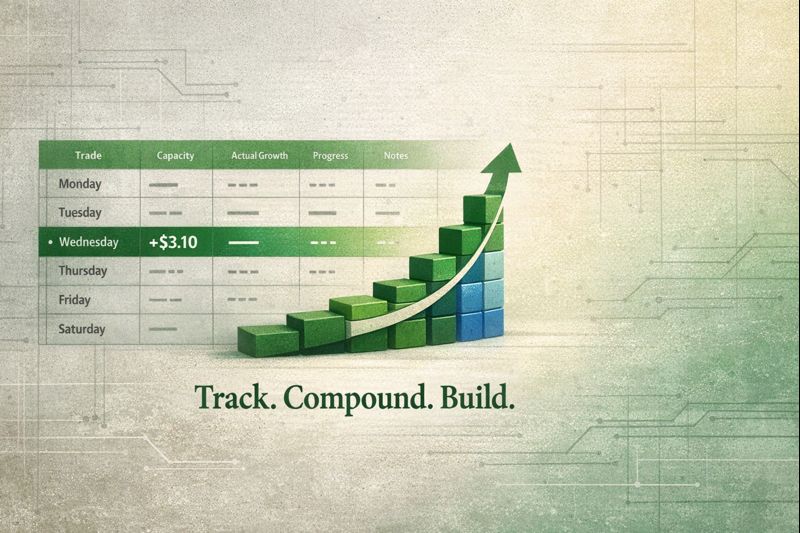
- Wednesday: +$3.10 → Thursday capacity = $8.50
- Continue through Saturday
3) Observe the Output (3 minutes)
- Watch how the chart updates in real time
- See how weekly return % reflects true performance
- Notice how lot size would adjust if you followed the VIX 75 guide
The Step-by-Step Tracker Guide
Step 1: Understand “Capacity”
- This is your current trading account size in USD.
- On Monday, it starts at $5.00—no exceptions.
- Every day after, it’s automatically updated from the prior day’s actual result.
💡 Think of it like concrete curing: each layer must set before you pour the next.
Step 2: Enter Your Actual Growth
In the Actual Growth column:
- Enter your real P&L for the day (e.g.,
+2.40,-1.10) - If you didn’t trade, enter
0.00 - Never leave it blank—blank = broken feedback loop
Step 3: Read Your Return %
- This shows (Actual Growth ÷ Capacity) × 100
- A +$1.00 day on $5.00 = +20% (strong)
- A +$1.00 day on $50.00 = +2% (normal)
- This keeps your ego in check
Step 4: Watch the Chart Update
- Green dot = profitable day
- Red dot = losing day
- Curve slope = compounding momentum
- Flat line = no progress (time to reassess)
Step 5: Use the VIX 75 Reference
- Find your current capacity in the table
- Use the recommended lot size
- Example: At $25.32 → 0.025 lots (Balanced risk)
- Never jump ahead—scale only when equity supports it
Step 6: Print Your Weekly Summary
- Click “📄 Print to PDF” every Sunday
- Review: Which days were profitable? Why?
- Store it in your “Trading Journal” folder
Understanding Your Results
Weekly Total Row
- Total Actual Growth: Sum of all daily P&L
- Weekly Return %: (Total Growth ÷ Monday’s Capacity) × 100
→ This is your true weekly performance metric
Growth Trajectory Chart
- Y-axis: Account equity over time
- X-axis: Trading days (Mon–Sat)
- Area under curve = compounding effect
- Sharp drops = over-leveraged or undisciplined
Position Sizing Tiers
| Balance | Lot Size | Risk Level |
|---|---|---|
| $5 | 0.005 | Ultra Conservative |
| $10 | 0.01 | Conservative |
| $20 | 0.02 | Moderate |
| $30 | 0.025 | Balanced |
| $40 | 0.03 | Aggressive |
| $100+ | 0.05 | High Growth |
⚠️ Warning: Moving up tiers too fast is the #1 cause of account death.
Common Problems (and what to do)
“My chart looks flat—I’m not growing”
Likely causes:
- Over-trading low-probability setups
- Ignoring position sizing rules
- Not logging losses honestly
What to do:
- Go back to $5.00 for one week
- Trade only 1 setup per day
- Follow the tracker exactly—no overrides
”I had a big win, but my return % seems low”
Example: +$10 on $50 capacity = +20% (not 200%)
What to do:
- Remember: return % is relative to your size
- This prevents ego inflation—$10 on $5 is 200%; on $50 it’s 20%
- Celebrate consistency, not spikes
”I lost everything—do I reset?”
Yes—but correctly:
- Close the current week
- Start fresh next Monday at $5.00
- Do not reload mid-week—that breaks the system
”Can I change the 50% target?”
You can mentally—but don’t edit the tool.
The 50% is a calibration benchmark, not a goal.
Your real goal is positive expectancy over 20+ weeks.
Try These Scenarios
Test the tracker with real examples:
Scenario 1: Consistent Grinder
- Mon: +$1.00 → Tue cap: $6.00
- Tue: +$0.90 → Wed cap: $6.90
- Wed: +$1.20 → Thu cap: $8.10
- Result: Steady upward curve, ~20% weekly return
Scenario 2: Emotional Trader
- Mon: +$3.00 → Tue cap: $8.00
- Tue: -$5.00 → Wed cap: $3.00
- Wed: -$2.00 → Thu cap: $1.00
- Result: Volatile chart, negative weekly return
Scenario 3: Disciplined Scaler
- Starts at $5 → grows to $37.98 by Saturday
- Follows VIX 75 sizing at every step
- Prints PDF, reviews Sunday
- Repeats next week with confidence
When to Use the Tracker
As a Beginner
- Build muscle memory for risk management
- Replace guesswork with structure
- Prove to yourself you can compound
During Live Trading
- Log results immediately after closing trades
- Let the tool auto-calculate next-day capacity
- Avoid manual math errors
In Mentorship Sessions
- Show your PDF journal to your coach
- Discuss patterns, not just wins/losses
- Align strategy with real data
When Scaling Up
- Use the final Saturday equity as seed capital
- Fund tools, courses, or materials (“Concrete”)
- Reinvest profits into your builder ecosystem
Key Takeaways
- Capacity = your truth—never fake it
- Actual Growth > Expected Equity—always
- Position size follows equity—not emotion
- Compounding is slow, then sudden—trust the process
- $5 is enough to start—if you’re honest
Next Steps
- 5 Ways to Fund Your Builds Without Clients
- VIX 75: A Builder’s Guide to Synthetic Indices
- Risk Management for Creative Entrepreneurs
- How to Keep a Trading Journal That Actually Works