
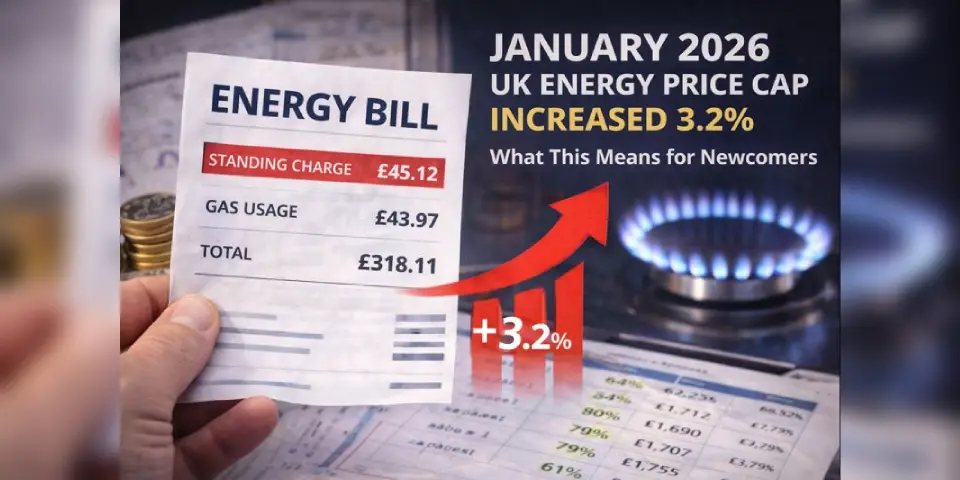
January 2026 UK Energy Price Cap Rose 0.2% – What This Actually Means for Newcomers
Last updated: 18 January 2026 | Reading time: ~12 minutes
28 pence.
That’s how much more the average UK household will pay per month under the new energy price cap that came into effect on January 1, 2026.
Not per week. Not per day. Per month.
If you’re new to the UK and saw headlines screaming about “energy prices rising again,” you probably felt that familiar knot of anxiety. Winter heating bills are already confusing enough without scary financial news.
But here’s what actually happened: Ofgem, the UK energy regulator, increased the price cap by 0.2% - one of the smallest adjustments they’ve ever made. For the typical household on a variable tariff, this means annual bills went from £1,755 to £1,758.
A £3 annual increase. Literally the cost of a coffee.
This isn’t a crisis. It’s barely a blip. But if you’re new to the UK, the way this information gets presented can make it feel catastrophic.
Let me cut through the noise and explain what actually changed, what it means for your specific situation, and - most importantly - what you absolutely should not do in response.
What This Guide Actually Covers
I’m not going to waste your time with corporate speak or recycled press releases. Here’s what you’ll learn:
The Reality:
- What the 0.2% increase actually means in pounds and pence
- Why your bill might not change at all (yes, really)
- The difference between headlines and your actual situation
The Specifics:
- Who is affected (and who isn’t)
- How the change breaks down by fuel type
- Regional variations that matter
- Payment method differences
The Action Plan:
- Whether you should switch suppliers (probably not because of this)
- What mistakes newcomers make after price cap news
- When the next change happens (and what to expect)
- How to actually reduce your bills (hint: it’s not about the price cap)
Who needs to read this:
- Newcomers trying to understand UK energy headlines
- Anyone on a standard variable tariff
- Renters who just received “your bills are changing” letters
- People panicking about winter costs
What the UK Energy Price Cap Actually Is (Without the Jargon)
Before we talk about what changed, you need to understand what the price cap even is - because most newcomers get this completely wrong.
What People Think It Is:
A maximum cap on your total energy bill.
What It Actually Is:
A maximum limit on the unit rates and standing charges suppliers can charge on standard variable tariffs.
Think of it this way:
The price cap sets:
- Maximum price per kilowatt-hour (kWh) of electricity
- Maximum price per kWh of gas
- Maximum daily standing charge
The price cap does NOT set:
- Your total monthly bill
- How much energy you use
- Whether you’ll pay more or less than your neighbor
Your actual bill is still determined by:
- How much energy you use (completely variable)
- Where you live (regional differences in standing charges)
- How you pay (direct debit, prepaid, or standard credit)
- What tariff you’re on (variable, fixed, or specialized)
Why This Matters:
Two people can be under the same price cap and pay wildly different amounts.
Example:
Person A: Lives alone in a well-insulated flat, uses 1,500 kWh electricity per year
→ January 2026 bill might be ~£70/month
Person B: Family home, poor insulation, uses 4,200 kWh per year
→ January 2026 bill might be ~£200/month
Same price cap. Totally different bills.
As a newcomer, this distinction is critical - because the price cap number you see in headlines (£1,758) might have nothing to do with what you’ll actually pay.
What Actually Changed on January 1, 2026
Now let’s look at the specific changes, with the actual numbers Ofgem published.
The Headline Figure:
Price cap increased from £1,755/year to £1,758/year
That’s a 0.2% increase, or £3 per year for typical dual-fuel (gas + electricity) usage.
In monthly terms: 28 pence more per month.
But Here’s What Makes This Confusing:
While the overall cap went up slightly, the components moved in opposite directions:
What Went Down:
- Gas unit rate: Decreased from 6.3p/kWh to 5.9p/kWh (6% reduction)
What Went Up:
- Electricity unit rate: Increased from 26.3p/kWh to 27.7p/kWh (5% increase)
- Gas standing charge: Increased from 34.0p/day to approximately 34.0p/day (minimal change)
- Electricity standing charge: Increased from 53.6p/day to 54.75p/day (2% increase)
What This Actually Means:
If you use mostly gas for heating:
You might actually pay less this quarter despite the “price rise” headlines, because gas unit rates dropped.
If you use mostly electricity:
You’ll pay slightly more, but we’re talking a few pounds per month at most.
If you use both (most people):
The changes roughly balance out, resulting in that tiny £3 annual increase.
The Three Different Price Caps (Yes, There Are Three)
Here’s something that confuses almost every newcomer: there isn’t one price cap - there are three different caps depending on how you pay.
Price Cap by Payment Method (Jan-March 2026):
1. Direct Debit (Most Common):
- £1,758 per year for typical usage
- This is the number you see in all the headlines
2. Prepayment Meters:
- £1,711 per year for typical usage
- Actually £47 CHEAPER than direct debit now
- Yes, you read that right - prepaid used to cost more, now it costs less
3. Standard Credit (Pay on Receipt):
- £1,894 per year for typical usage
- Most expensive option
- You pay quarterly after using energy
Why These Differences Exist:
Direct debit is cheapest because:
Suppliers get predictable monthly payments, lower administration costs, and guaranteed payment.
Prepaid is now cheaper than direct debit because:
Recent Ofgem regulations aimed to eliminate the “poverty premium” where the poorest (often on prepaid) paid the most.
Standard credit is most expensive because:
Suppliers face higher risk of non-payment and more administrative burden chasing quarterly bills.
What This Means for You:
If you’re on prepaid and feeling bad about it - stop. You’re actually getting the cheapest rates right now.
If you’re on standard credit and could switch to direct debit - you could save £136/year just by changing payment method.
Who Is Actually Affected by This Change
Not everyone’s bills changed on January 1. Here’s who is and isn’t affected:
✅ Your Bills Changed If You’re On:
- Standard variable tariff (also called “default tariff”)
- Flexible tariff (Octopus Energy’s variable option)
- Variable rate tariff with any supplier
- Tracker tariff (tracks wholesale prices)
How to check: Look at your latest bill. Under “tariff type” or “tariff name,” if it says “variable,” “standard,” or “flexible,” you’re affected.
❌ Your Bills DIDN’T Change If You’re On:
- Fixed tariff (locked-in rates for 12-24 months)
- Time-of-use tariff like Octopus Agile (different pricing system)
- Any deal signed before the price cap change
How to check: If your tariff has an end date and promises fixed rates until then, January’s price cap change doesn’t touch you.
Why This Matters:
Roughly 65-70% of UK households are on variable tariffs affected by the price cap.
But 30-35% aren’t - and those people are reading headlines about price rises that don’t apply to them at all.
If you moved to the UK recently and just accepted whatever tariff came with the property, you’re almost certainly on a variable tariff and are affected.
How This 0.2% Increase Actually Shows Up On Your Bill
Let’s make this concrete with real examples based on actual usage patterns.
Example 1: Small Flat, Single Person (Low Usage)
Profile:
- 1-bedroom flat
- Good insulation
- Just you living there
- Annual usage: 1,500 kWh electricity, 7,000 kWh gas
October-December 2025 quarterly bill: ~£283
January-March 2026 quarterly bill: ~£284
Increase: £1 per quarter (about 33p per month)
Example 2: Average UK Household (Typical Usage)
Profile:
- 2-3 bedroom house
- Average insulation
- 2-4 people
- Annual usage: 2,700 kWh electricity, 11,500 kWh gas
October-December 2025 quarterly bill: ~£439
January-March 2026 quarterly bill: ~£440
Increase: £1 per quarter (about 28p per month - exactly what Ofgem said)
Example 3: Large Family Home (High Usage)
Profile:
- 4-bedroom detached house
- Poor insulation (pre-1990s build)
- 4-5 people
- Annual usage: 4,500 kWh electricity, 18,000 kWh gas
October-December 2025 quarterly bill: ~£710
January-March 2026 quarterly bill: ~£712
Increase: £2 per quarter (about 67p per month)
What These Examples Reveal:
Even in the worst case (large, poorly insulated house with high usage), we’re talking about 67 pence more per month.
For most newcomers in rental flats or shared houses, the increase is literally less than £1 per month.
This is not the crisis the headlines suggest.
What Drove This Tiny Increase (The Real Story)
If wholesale energy prices actually fell slightly, why did the cap go up at all?
Because the price cap isn’t just about wholesale costs. Here’s what actually happened:
Component Breakdown of the January 2026 Cap:
Wholesale energy costs: ~39% of your bill
→ Actually decreased slightly this quarter
Network costs: ~21% of your bill
→ Stayed roughly stable
Policy costs: ~13% of your bill
→ Increased (this is the culprit)
Operating costs: ~12% of your bill
→ Increased slightly
VAT: 5% of your bill
→ Unchanged
Profit margin: ~3% of your bill
→ Capped by regulation
What Actually Pushed Prices Up:
1. Sizewell C Nuclear Funding:
The government added a charge to fund construction of the Sizewell C nuclear power station. This adds approximately £1 per month to your bill.
2. Warm Home Discount Expansion:
The scheme that provides £150 support to vulnerable households expanded, spreading the cost across all customers. Adds roughly 75p per month.
3. Updated “Typical Usage” Benchmark:
Ofgem revised their calculation of what “typical” usage actually is, based on current customer behavior. This technical change added about 75p per month to bills.
Total from these policy decisions: ~£2.50 per month
Offset by lower wholesale costs: ~£2.22 per month
Net result: 28p monthly increase
Why This Matters:
The price cap rise had nothing to do with the energy you’re actually using getting more expensive.
It was almost entirely driven by government policy decisions to fund nuclear infrastructure and expand support for vulnerable households.
Reasonable people can disagree about whether these are good policies, but they’re not a sign of an “energy crisis” returning.
Should You Switch Suppliers Because of This?
Short answer: Almost certainly not.
Longer answer: Switching suppliers is sometimes a good idea, but the January 2026 price cap change - in isolation - is absolutely not a reason to do it.
Why Switching Now Is Probably Wrong:
1. The increase is too small to matter
Even if you found a tariff 5% cheaper, you’d save maybe £7-8 per month. Factor in the hassle, and it’s barely worth it.
2. Most competitive fixed deals are more expensive
As of mid-January 2026, the cheapest fixed tariffs are typically £50-100 more expensive per year than the variable price cap.
3. Wholesale prices are expected to fall in April 2026
Analysts at Cornwall Insight predict the April-June 2026 price cap will decrease by approximately £138/year.
If you lock into a fixed deal now to “escape” a £3 annual increase, you’ll miss out on a potential £138 annual decrease in three months.
That would be spectacularly bad timing.
4. Exit fees can wipe out any savings
Many fixed tariffs have £30-60 exit fees per fuel. If you switch now and then want to switch again in April when prices fall, you could pay £120 in exit fees to save £3.
The math doesn’t work.
When Switching Does Make Sense:
Switch if:
- ✅ You find a tariff at least 10% cheaper than the price cap
- ✅ You’re unhappy with your supplier’s customer service
- ✅ You’re on an expensive fixed deal that’s about to end
- ✅ Your standing charges are unusually high for your region
- ✅ You want a specialized tariff (time-of-use, 100% renewable, etc.)
Don’t switch if:
- ❌ You’re reacting to a single price cap announcement
- ❌ The savings are less than £10/month
- ❌ There are exit fees and you might switch again soon
- ❌ You switched in the last 3 months (give it time to stabilize)
Common Newcomer Mistakes After Price Cap Announcements
I see these mistakes constantly from people new to the UK. Avoid them:
Mistake #1: Panic-Switching to the First “Cheaper” Option
The Trap: Comparison sites show a tariff that’s “£50 cheaper per year!” so you switch immediately.
The Reality:
- You didn’t check exit fees (£60)
- You didn’t notice it’s a 1-year fix that ends in October (when prices might be lower)
- You didn’t calculate what “typical usage” means vs. YOUR usage
- You didn’t research the supplier’s customer service (they have a 1.2-star Trustpilot rating)
The Outcome: You saved nothing and created a headache.
Mistake #2: Assuming the Price Cap Determines Your Bill
The Trap: “The price cap is £1,758, so that’s what I’ll pay this year.”
The Reality:
The £1,758 figure is for “typical” usage: 2,700 kWh electricity and 11,500 kWh gas.
If you’re a single person in a flat, you might use 1,200 kWh electricity and 6,000 kWh gas → Your bill will be ~£900-1,000.
If you’re a family in a large house, you might use 4,000 kWh electricity and 18,000 kWh gas → Your bill will be ~£2,800-3,000.
The price cap is a rate limit, not a bill predictor.
Mistake #3: Locking Into Long Fixed Deals Out of Fear
The Trap: “Prices are rising! Better lock in a 2-year fix to protect myself!”
The Reality:
Fixed deals currently cost MORE than the variable price cap.
If you lock in now:
- You’ll pay £50-150 more per year than staying on variable
- You’ll miss out when the cap potentially drops in April
- You’ll pay exit fees if you want to leave early
When fixes make sense: When they’re cheaper than the variable cap AND you value certainty over savings.
When they don’t: Right now, for most people.
Mistake #4: Ignoring Standing Charges
The Trap: “This tariff has a lower unit rate, so I’ll save money!”
The Reality:
A tariff with 24p/kWh electricity and 60p/day standing charge can cost MORE than one with 28p/kWh and 45p/day standing - depending on your usage.
If you use very little energy, high standing charges crush you. If you use a lot, high unit rates crush you.
You need to calculate based on YOUR actual usage, not just compare headline rates.
Mistake #5: Believing “Comparison Sites” Are Impartial
The Trap: “The comparison site recommended this supplier, so they must be best.”
The Reality:
Many comparison sites earn commission from suppliers. The “recommended” or “featured” deals often pay the highest affiliate fees.
Always:
- Check multiple comparison sites
- Look at Trustpilot reviews separately
- Verify the actual T&Cs on the supplier’s website
- Calculate total cost yourself (don’t trust the estimate)
What You Should Actually Do Right Now
Forget reactive panic. Here’s a sensible, evidence-based plan:
Week 1: Gather Information
1. Find your current tariff details:
- Log into your energy supplier account
- Find tariff name, unit rates, standing charges, and end date
- Note whether you’re on variable or fixed
2. Check your actual usage:
- Look at the last 3-6 months of bills
- Calculate average monthly kWh for electricity and gas separately
- Note if winter usage is much higher (normal in the UK)
3. Identify your payment method:
- Direct debit, prepaid, or standard credit?
- If prepaid, could you switch to direct debit to save £47/year?
Week 2: Compare Properly
1. Use multiple comparison sites:
- Uswitch
- MoneySuperMarket
- Compare the Market
- Which? Energy Switch
2. Input YOUR actual usage:
- Don’t accept the default “typical” assumptions
- Use your actual kWh numbers from Week 1
3. Filter intelligently:
- Set minimum review rating (4.0+ stars)
- Check for exit fees
- Note contract length
- Look for hidden clauses
4. Calculate total annual cost: Unit cost = (Your annual kWh × unit rate) + (365 × daily standing charge)
Do this for both your current tariff and any alternatives.
Week 3: Make a Decision
If you find a deal that’s £100+ cheaper per year with no major downsides: → Consider switching
If the savings are £30-60 per year: → Probably not worth the hassle unless you’re already unhappy with your supplier
If everything is roughly similar: → Stay put and check again in March before the April price cap change
Alternative Strategy: Wait Until March
Seriously consider doing nothing until late March.
Why?
- April’s price cap announcement comes in late February
- If it drops by £138 as predicted, staying on variable is clearly right
- If it rises unexpectedly, you can switch then
- Three months of tiny increases (£3 total) won’t hurt you
Patience often beats panic.
When the Next Price Cap Changes Happen (Mark Your Calendar)
The price cap changes quarterly. Here’s the schedule:
April 1, 2026 (Announcement: Late February)
→ Predicted: Decrease of ~£138/year
→ This is the one to watch
July 1, 2026 (Announcement: Late May)
→ Typically lower than winter quarters
→ Summer usage drops significantly
October 1, 2026 (Announcement: Late August)
→ Typically rises slightly heading into winter
→ This is when many people switch to fixed deals
January 1, 2027 (Announcement: Late November 2026)
→ Full winter pricing in effect
What This Pattern Means:
Don’t make decisions based on one quarter.
Look at the annual trend. As of January 2026, typical annual bills are:
- 45% higher than pre-crisis (winter 2021/22)
- 26% lower than the peak crisis (October 2022-June 2023)
- Roughly stable for the past 18 months
We’re not in crisis mode. We’re in “new normal, higher than before, but stable” mode.
How to Actually Reduce Your Energy Bills (Ignore the Price Cap)
Want to know the truth?
Whether the price cap is £1,755 or £1,758 makes almost zero difference to your quality of life.
What actually matters is reducing your consumption and optimizing your payment method.
Changes That Save Real Money:
1. Switch from Standard Credit to Direct Debit
→ Saves £136/year
→ No usage change required
2. Request a Smart Meter (If You Don’t Have One)
→ Real-time usage tracking
→ Helps identify waste
→ Enables time-of-use tariffs (Octopus Agile, etc.)
3. Insulation and Draft-Proofing
→ Can save £100-300/year
→ Government grants often available
→ Check: simpleenergyadvice.org.uk
4. Adjust Heating Behavior
→ 1°C lower = ~10% savings
→ Heating specific rooms vs. whole house
→ Timer optimization (heat before you wake, off when you sleep)
5. Phantom Load Elimination
→ Devices on standby waste 10% of electricity
→ Smart plugs can automate this
→ Costs £20 upfront, saves £50-80/year
6. Switch to LED Bulbs
→ 75-80% less electricity than incandescent
→ £2-3 per bulb, saves £5-10 per bulb per year
The Real Math:
Switching suppliers due to 0.2% price cap rise:
→ Potential savings: £3-10/year
→ Time investment: 2-3 hours
→ Stress level: Medium-high
Switching to direct debit + basic efficiency measures:
→ Potential savings: £200-400/year
→ Time investment: 1-2 hours
→ Stress level: Low
The price cap changes are noise.
Your behavior and payment method are signal.
What This Price Cap Change Actually Tells Us
Stepping back from the immediate details, here’s what January 2026’s 0.2% increase reveals about the UK energy market:
1. The Crisis Is Over (For Now)
From October 2022 to early 2024, price cap volatility was extreme. Quarter-on-quarter changes of 20-50% were common.
Since July 2024, changes have been:
- July → October 2024: 10% decrease
- October → January 2025: Small increase
- January → January 2026: 1% increase year-on-year
We’re back to stability. Not cheap - prices are still 45% higher than pre-crisis - but stable.
2. Policy Costs Are Rising
Wholesale energy costs are stable or falling slightly.
But policy costs (green levies, nuclear funding, social programs) are rising steadily.
This means future price cap increases will likely come from government decisions, not global energy markets.
As a consumer, you can’t do much about this - it’s political, not personal.
3. Regional Variations Matter More Than Ever
The “typical” price cap figure hides huge regional differences in standing charges.
Example:
- South Wales: Gas standing charge ~38p/day
- London: Gas standing charge ~29p/day
That’s a £33/year difference just from where you live.
Check your specific regional rates - the national average might not apply to you.
4. Payment Method Matters More Than Tariff Choice
The difference between payment methods (£136/year) is vastly larger than typical savings from switching suppliers (£20-50/year).
Optimize your payment method before obsessing over supplier choice.
5. Predictions Are Increasingly Reliable
Because wholesale prices have stabilized and the formula is transparent, we can now predict price cap changes with decent accuracy 3-6 months out.
Cornwall Insight’s prediction of a £138 decrease in April has a good track record. This wasn’t possible in 2022-23 when markets were chaotic.
Use these predictions to time switches intelligently.
For International Students and New Immigrants Specifically
If you’re brand new to the UK, the energy price cap system can feel completely alien. Here’s what’s different from most other countries:
Differences From Common Systems:
USA: No price cap, fully deregulated in most states
EU: Price caps exist but work differently (often subsidized)
India: Government-set tariffs, less market variability
China: State-controlled pricing, no cap needed
Australia: No national cap, state-level regulation varies
What makes the UK unique:
- Quarterly price cap changes (not annual or fixed)
- Separate caps for unit rates and standing charges
- Different caps by payment method
- Transparent methodology published by Ofgem
- Wholesale markets determine cap, not direct government subsidy
Cultural Context:
In many countries, you just pay your bill and don’t think about it.
In the UK post-2022, energy has become a major topic of public anxiety and political debate.
People talk about their energy bills at parties. Comparison sites are mainstream. “Did you switch?” is normal conversation.
This is a cultural adaptation to a system that demands consumer engagement.
Student-Specific Advice:
If you’re in university accommodation:
Bills are usually included. The price cap doesn’t affect you at all. Ignore the headlines.
If you’re in a private rental sharing with housemates:
- Put one person in charge of the energy account
- Split bills monthly based on actual usage
- Consider a “house kitty” for bills to avoid awkward chasing
- Check if you can switch to direct debit for the £136 saving
If you’re here on a work visa in your own place:
- Treat energy setup as a priority in week one
- Don’t accept the default tariff forever
- Set calendar reminders for price cap announcement dates
- Consider this part of “UK life admin literacy” you need to develop
Final Thoughts: Perspective on a 28p Increase
Here’s what I want you to take away from this:
The January 2026 energy price cap increase is not a crisis.
It’s 28 pence per month. Less than a coffee. Less than a bus ride. Less than a loaf of bread.
But the way this information gets presented - “Energy bills to rise AGAIN,” “Struggling households face MORE increases,” “Price cap CLIMBS” - is designed to generate clicks, not clarity.
As a newcomer to the UK, you’re particularly vulnerable to this panic because:
- You don’t have context for what’s normal
- You’re already stressed about adapting to a new country
- You might not have a support network to reality-check with
- The terminology is unfamiliar
Here’s the perspective I wish someone had given me:
Yes, UK energy is more expensive than it was in 2021.
Yes, it’s frustrating that prices haven’t fully returned to pre-crisis levels.
Yes, standing charges are too high and regressive.
But no, a 0.2% quarterly adjustment is not a reason to panic, switch suppliers, or stay up at night worrying.
What actually matters:
- Understanding the system so you can make informed choices
- Optimizing your payment method (biggest quick win)
- Reducing consumption through behavior and efficiency
- Timing switches strategically (wait for April if you’re going to switch)
- Keeping perspective when headlines scream
You’re going to see three more price cap announcements this year alone.
Some will be increases. Some will be decreases. All will generate headlines that sound scary.
Your job isn’t to react to every single one.
Your job is to:
- Check if you’re affected
- Calculate the actual impact in pounds
- Make deliberate decisions based on YOUR usage and situation
- Ignore the noise
The UK energy system is complex and imperfect.
But it’s also predictable, regulated, and - honestly - not as bad as the headlines suggest.
You’ve got this.
Still confused about something? Drop a question in the comments. I’m here to help, and your question might help another newcomer too.
Data sources:
- Ofgem Official Announcements (accessed 18 January 2026)
- House of Commons Library Research Briefings (accessed 18 January 2026)
- Energy UK Analysis (accessed 18 January 2026)
- MoneySavingExpert Price Cap Tracker (accessed 18 January 2026)
- Cornwall Insight Market Forecasts (accessed 18 January 2026)
All figures verified against:
Ofgem’s “Energy price cap levels: 1 January to 31 March 2026” official publication
Related Content You’ll Find Useful
Understanding UK Energy:
- My First UK Energy Bill Made No Sense - Line by Line Explanation
- UK Energy System Explained - Suppliers vs Network Operators
- Standing Charges By Region - Complete Data Analysis
Reducing Costs:
- How to Switch UK Energy Providers - First-Timer’s Complete Guide
- The UK Energy Mistake That Cost Me £180 in My First Month
- Prepaid vs Credit Meter - Which Actually Costs Less?
Historical Context:
- I Analyzed 7 Years of UK Energy Price Caps - What the Data Shows
- Why UK Energy Costs 45% More Than Before (And Why It Won’t Drop Back)
💡 Want to Compare Energy Deals Properly?
Use these comparison tools to check if switching actually makes sense for YOU:
- Uswitch Energy Comparison - Independent comparison with actual customer reviews
- Which? Energy Switch - Consumer advocate, no supplier bias
- MoneySavingExpert Energy Club - Martin Lewis’s recommended approach
Always input your ACTUAL usage from bills, not the default “typical” estimates. The difference can be £100+ per year.